
Why passive fire protection still lacks its own field of study
Passive fire protection is carried out by professional specialists across the country, but in the building regulations it does not exist as its own field. This has consequences for the entire industry, says fire engineer Morten Iversen Berland of the engineering company Ignist, who calls for formal education, mandatory final inspections, and stronger standardization.
When fire engineer Morten Iversen Berland is asked how often he finds errors during independent inspections, the answer is as blunt as it is alarming:
“It sounds a bit flippant, but I always find errors. The question is how many, and how critical they are.”
– Morten Iversen Berland, Ignist
Berland is the managing director of Ignist, a multidisciplinary fire safety engineering company he founded together with fire safety consultant Joakim Folkesson in 2021. With 25 years of experience in the construction industry—first as an electrician, then as a fire engineer, including as team leader for fire consulting at Høyer Finseth and WSP—he has seen the challenges from multiple sides. He has also worked on product development and testing of fire protection products at Polyseam, giving him hands‑on expertise in fire sealing that few consultants possess.

Finished at the Building Permit Stage
One of the most surprising realities Berland describes is that the fire engineer’s formal responsibility in a construction project ends at the issuance of the building start permit (IG). At that point, the fire safety concept—the report outlining the fire safety requirements for the building—has been delivered and checked. The documents are signed. And then it is up to others to follow through.
“We write it in one sentence in the fire concept, and then we’re done when the building start permit is granted. Then others take over— and many, many people forget about it.”
– Morten Iversen Berland
In practice, this means there is no mandatory requirement for a fire consultant to inspect the completed building. Municipalities can require it, but rarely do. Any errors in fire sealing may remain undetected for years—until the fire service conducts an inspection, or the worst-case scenario occurs. And when errors are discovered, it is typically the building owner who bears responsibility, regardless of who actually performed the work.
A Discipline Without Formal Recognition
There is no formal education for passive fire protection in Norway. In the building regulations, fire sealing is not defined as a separate discipline. Responsibility is spread across other trades: plumbers, sheet metal workers, and carpenters handle fire sealing as part of their own scopes of work. Berland believes this is a fundamental weakness in the system.
“The competence you get in a construction project is random. You might be lucky and get a sprinkler engineer who loves sprinkler systems and is really good at it. But you might also get an HVAC consultant who just does it as a side task.”
– Morten Iversen Berland
The industry has, in practice, stepped in to fill the void. Dedicated fire‑sealing companies have built specialist expertise over many years and perform work requiring deep knowledge of products, configurations, and test documentation. But this competence is not anchored in regulations.
Øivind Sletten Berg from Mr Fug Brannsikring has worked with passive fire protection for 25 years and has seen the development up close:
“When I started with fire protection 25 years ago, fire sealing was just something that cost money and had to be minimized as much as possible. We rarely had time allocated in the project schedule. Today, we’re increasingly involved already in the design phase, and we see that tenders more often go to serious actors with documentation as their backbone. But we still lack a formal seat at the table.”
– Øivind Sletten Berg, Mr Fug Brannsikring
The problem is amplified by the fact that errors in fire sealing are rarely noticeable on a day-to-day basis. Unlike leaks or acoustic issues—where consequences are immediate—fire safety failures remain invisible until catastrophe strikes.
“A fire is never the first warranty issue after a building is completed. It’s only when it burns that this kind of issue emerges.”
– Morten Iversen Berland
Berland compares the situation with his own electrician certification, which includes apprenticeship programs, multi‑stage approvals, and installation requirements. For fire sealers, no such apprenticeship path exists. Courses are currently the most important tool for competence building, but Berland believes the industry needs a formal educational track in addition.
Construction Foam, Fire Foam, and Common Errors
When Berland performs inspections, he sees a set of recurring issues: too many penetrations through a wall without considering limitations, penetrations left unsealed, and incorrect product choices.
“Construction foam is a repeat offender. Some people love it. And it burns really well.”
– Morten Iversen Berland
He also warns against one‑component foams marketed as fire‑retardant. Berland is clear: the only approval he knows of for such foam applies to sealing between two concrete structures. Approved two‑component fire foams exist, but these too must be tested for the specific configuration.
Often the root cause is lack of knowledge. A plumbing apprentice who learns to fire seal small pipes from a colleague may continue using the same method for their entire career—without ever knowing if it is correct.
The Right Product in the Right System
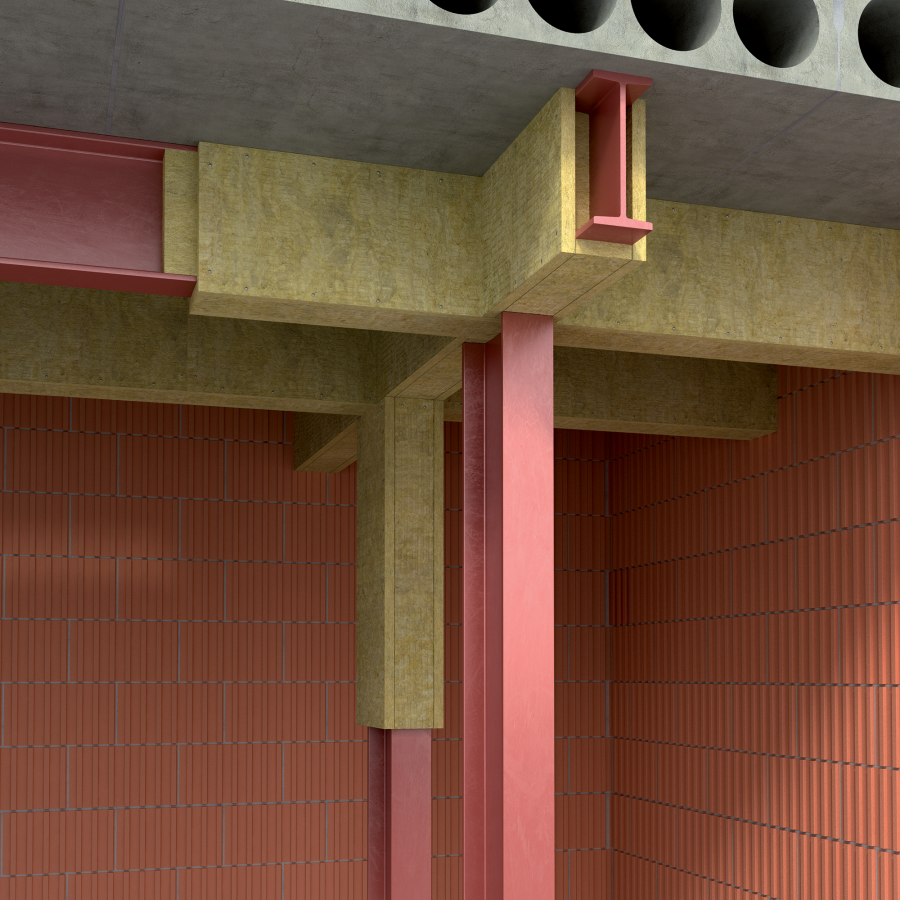
Fire sealing is a system issue, Berland emphasizes. A door with everything inside the opening is a system and must be tested as a whole. If the installation guide specifies stone wool, you must use stone wool—the correct type and density. Fire sealing goes hand‑in‑hand with stone wool: you pack it into the opening and apply sealant on top. It sounds simple, but the details determine whether the solution holds for 30, 60, or 90 minutes.
It is permitted to use products from different suppliers in different places in the same building, as long as each product is tested and approved for the applicable configuration. But Berland recommends sticking to one supplier throughout a project, both for control of limitations and for easier future maintenance.
With new materials constantly entering the market—especially various types and dimensions of plastic pipes—this is becoming ever more challenging. Each type must be tested separately, and different configurations produce different results.
When Theory Meets the Construction Site
A concrete example illustrates the gap between theory and reality. Trond Erik Johansen at ISOPARTNER highlights a recurring issue: fire insulation of ventilation ducts where the insulation is fastened with screws, even though the products were tested on welded ducts with no perforation.
“Those who performed the tests say you should not use screws, and then that’s the rule. And yet screws are used anyway.”
– Trond Erik Johansen, ISOPARTNER
The example underscores a crucial point: when test bases do not cover everyday practice, a knowledge gap forms—leaving tradespeople to make decisions without proper guidance. Screws in a ventilation duct mean holes, and holes mean potential air and oxygen supply to a fire.
NS 3962: A New Standard for Inspection
For years, there was no unified standard for how fire safety should be inspected throughout a construction project. Different companies used different methods, and quality varied.
“There’s nothing very new or revolutionary here, but it consolidates knowledge in one place. Standardization is simply about ensuring people perform work in a similar manner.”
– Morten Iversen Berland
In September 2024, Standard Norge published NS 3962 “Fire Safety: Inspection of Production Basis, Execution, O&M and Product Documentation.” The standard gives concrete requirements for how inspections must be carried out throughout the construction process. The Norwegian Building Authority (DiBK) is now considering referencing NS 3962 in the building regulations (SAK10), which would give the standard direct regulatory weight.
The establishment of a standard is, in itself, a sign of a maturing industry. A similar proposal was voted down around 2010 due to cost concerns. The fact that NS 3962 is now adopted—and that DiBK is considering anchoring it in regulation—shows that both authorities and industry actors take passive fire protection more seriously than before. Still, the standard addresses inspection—not education or formal recognition of the trade. Work remains.

The Road Ahead
Berland paints a picture of an industry in transition. The most important steps he calls for are:
- Formal education in passive fire protection
- Mandatory final inspections of fire protection work in new buildings
- A national standard ensuring uniform inspection practices
With NS 3962 in place, one of the three has been achieved. The direction is right, but there is more work ahead.
At ISOPARTNER, NS 3962 confirms what we see daily. Together with our manufacturers, we contribute to competence building through product guidance, training, and close collaboration with those performing the work. The right product in the right system is not just a matter of delivery—it is a matter of fire safety.
ABOUT IGNIST
Ignist AS is a multidisciplinary engineering company specializing in fire safety, founded in 2021 by Morten Iversen Berland and Joakim Folkesson. The company name comes from the Latin word ignis, meaning “flame.” More info: ignist.no
ABOUT NS 3962
NS 3962 “Fire Safety: Inspection of Production Basis, Execution, O&M and Product Documentation” was published by Standard Norge on 5 September 2024. DiBK is considering referencing the standard in SAK10.